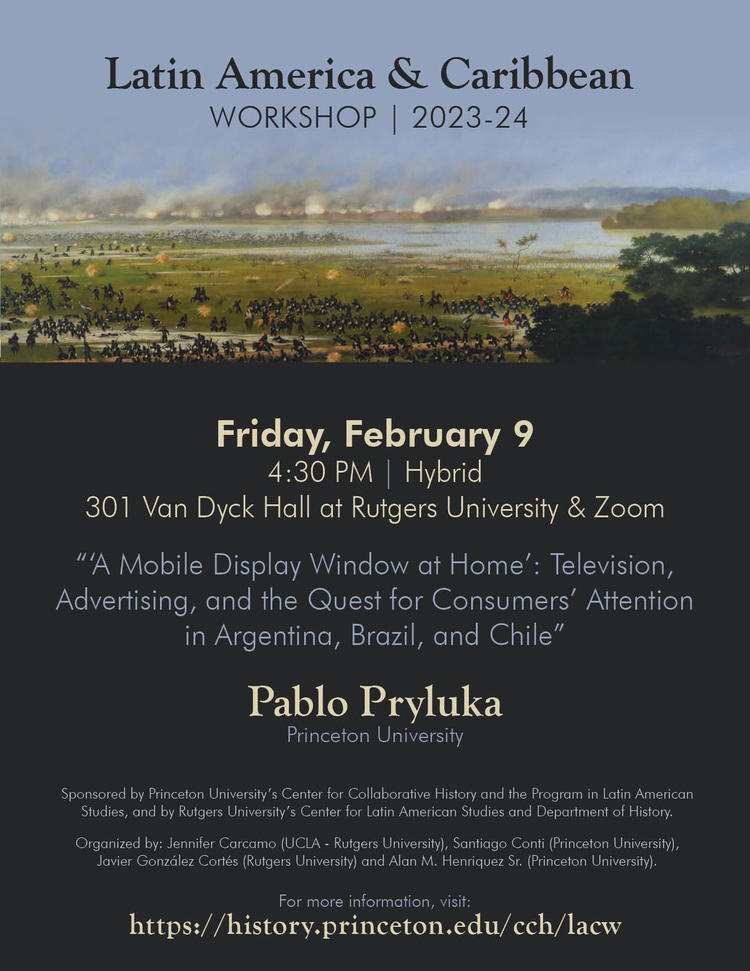
How advertising and television interacted depended on several factors, such as state regulations on advertising, the model for television broadcasting, or income levels. On the other hand, this interaction between advertising and television conditioned the consumer culture that emerged over the 1950s and consolidated in the 1960s. In this chapter, the speaker will explore how this interaction between television and advertising took place in Argentina, Brazil, and Chile. The chapter is divided into four sections. First, the speaker will reconstruct the origins of television broadcasting and the first attempts to promote the sales of TV receivers in the three countries. In the second part, the speaker will explore the emergence of a commercial television system in Argentina and Brazil. Third, the speaker will delve into the university television system that worked in Chile over the 1960s and the making of a national state TV station by the decade's end. Finally, he will show how the different paths followed in each country gave birth to a different consumer market model over time
Speaker Bio:

Pablo Pryluka is a Ph.D. candidate in the Department of History. He is a modern Latin American and global historian interested in the intersection of public policy, economic expectations, and the history of commodities. His research looks at the unintended social and political consequences of developmentalism through the lens of consumption. His dissertation focuses on the years after World War II when Latin American countries simultaneously expanded the welfare state and implemented import substitution policies. As a result, countries like Argentina, Brazil, and Chile experienced domestic market growth: as incomes increased, so did access to new durable goods that would transform everyday life.
This workshop will be held at Rutgers University (301 Van Dyck Hall) in hybrid (in-person and Zoom).
SPONSOR: Princeton University’s Center for Collaborative History and the Program in Latin American Studies, and by Rutgers University’s Center for Latin American Studies and Department of History.