
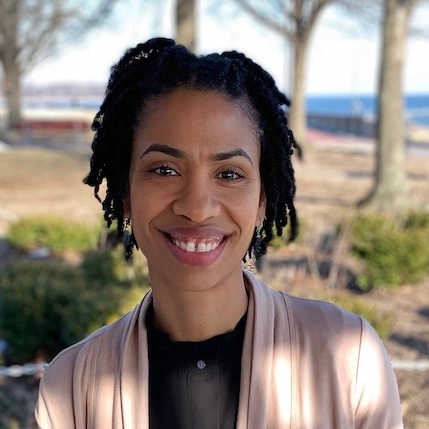
Kaysha Corinealdi is the author of Panama in Black: Afro-Caribbean World Making in the Twentieth Century (Duke University Press, 2022), with other publications in Radical History Review, Public Books, the American Historical Review, Social Text, The Washington Post, and Signs: Journal of Women in Culture and Society, and more. She is currently on the editorial board of the Global Black Thought journal and the University of North Carolina Press Latinx History Series and is an active member of the Association of Caribbean Women Writers and Scholars (ACWWS), the Dark Room: Race and Visual Culture Seminar, the American Studies Association (ASA), and the Museums Association of the Caribbean (MAC). Recently, she became an associate professor in the Department of Latino and Caribbean Studies.
Read on to get to know Kaysha Corinealdi a little better, and to get a deeper insight into her research interests, academic goals, and more.
Please tell us more about your new position.
My official title is Associate Professor of Comparative Caribbean and Hemispheric Transnationalisms. A mouthful, I know. The goal of the position is to strengthen the focus within LCS of looking at a multi-lingual and diasporic Caribbean that connects all parts of the Americas. The idea being, why not study Jamaica, Costa Rica, the U.S., and Guadeloupe together? Another important part of the position focuses on addressing anti-Blackness and xenophobia within Latinx and Caribbean communities, with an eye to thinking through how to create inclusive and just communities.
Can you tell us a little bit about your background?
I was born in Panama and came to the States with my family at age 11. I credit really phenomenal teachers in high school and professors in college who encouraged me to pursue a career as a scholar and professor. My thought at the time was "you mean I can just read, write, and talk about my research as a career? Where do I sign up?" I completed my PhD in History from Yale University and have taught at a couple of institutions, most recently at Emerson College. Making the move to LCS and Rutgers was a natural transition. I am very excited to teach classes focused solely on the Americas, on a campus with a student population with rich roots in the Caribbean and Latin America, and to work alongside colleagues whose scholarship I deeply admire. At Rutgers I also look forward to continuing my research on Afro-diasporic activism in the Americas.
You mentioned a little about your research interests regarding Afro-diasporic activism. Can you expand on that?
My first book, Panama in Black, connected Panama and the U.S. through the histories of Afro-Caribbean migrants and their descendants. I am now looking at self-described internationalists, especially women, in Panama during periods of intense anti-communist policing. My current project is what I am calling a speculative biography of Thelma King, one such internationalist. The project combines in-depth research with some first-person and investigative narrative.
What courses will you be teaching? What topic are you most looking forward to teaching?
This spring I am teaching 595:100-Introduction to Caribbean Studies. And I must say that I have some really engaged students. Next semester I will be teaching 595:205/508:272-History of the Caribbean since 1898 and 595:312/508:362-Afro-descendants in Central America. I am excited to teach both courses but in particular Afro-descendants in Central America since I plan to incorporate novels, podcasts, music, recent cutting-edge scholarship, and visits from scholars and artists.
What do you want to accomplish during your time in this position? Any future projects?
My hope is to get even more students excited to learn about our Americas. We so often study nation states in silos and miss the cultural, political, and artistic connections and tensions (which are also important to study) that have been there all along. I am also looking forward to working with student researchers on digitization and public history scholarship connected to my Thelma King project and to building bridges between LCS/Rutgers and universities in the Caribbean.
Sincere thanks to Kaysha Corinealdi for participating in this interview. The CLAS community extends a heartfelt welcome and we look forward to exploring and reading more about her work in the future. Kaysha can be reached at