
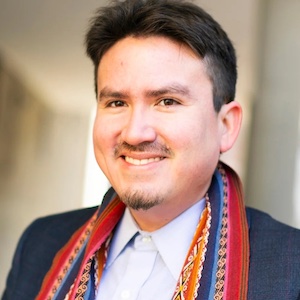
The upcoming 2025 Andean and Amazonian Symposium will feature Américo Mendoza Mori, Ph.D., Harvard University as keynote speaker. He will be giving a presentation on "Global and Migrant Indigeneity: Quechua Language Reclamation in the Andes and Beyond”. In the lead up to the symposium, Dr. Mori sat down with event organizer Paul Montjoy Forti for an interview about the Quechua language. Read the interview below.
1. What role do Indigenous languages, like Quechua, play in Latin American and Latinx identities?
Indigenous languages like Quechua, Nahuatl, and Mayan are crucial in shaping Latin American and Latinx identities. They offer a powerful connection to our cultural heritage, linking us not just to the past, but also to the vibrant, contemporary aspects of our societies. In the diaspora, these languages give communities the strength to reclaim their voices and assert their unique identities, even as they navigate the broader notion of Latinidad, which has often overlooked Indigenous and Afro-diasporic identities. Quechua, in particular, with almost 10 million speakers, is a representation of the rich culture of the Andean people, helping expand the diverse narratives within the Latino community.
2. How do migrant communities from the Andes incorporate Quechua into their lives in the U.S.?
Many Andean migrant communities in the U.S. actively weave Quechua into their everyday lives through cultural reclamation and community initiatives. They organize language classes, cultural celebrations, and storytelling events across generations, using Quechua to empower themselves and reinforce their identities. This approach helps them maintain strong cultural connections while also challenging typical perceptions of language and identity in the U.S. The New Jersey/New York metro area is a prime example of these dynamics, thanks to its significant population of Peruvian and Ecuadorian immigrants and their descendants. A special shoutout goes to PASA, the Peruvian American Student Association at Rutgers for the amazing work on fostering community, and for inviting me a few years ago to facilitate a Quechua language and culture workshop.
3. What is the contemporary relationship between Quechua, Spanish, and English?
Quechua and Spanish have been intertwined for about 500 years, influencing each other in fascinating and complicated ways due coloniality. Many people might not realize it, but they use Quechua words in their daily Spanish without even knowing (quinoa, llama, papa, cancha, etc). As I pointed out in the article “Quechuactivism in Social Media Digital Content and Indigenous Language Awareness,” English has also started to play a big role in the Andes, due to social media, technology, and of course in the experience of Andean migrants in the U.S. who use it to settle into their new environments.
Something really exciting is the growing interest in U.S. academia about using Indigenous concepts and perspectives. In my article, "Embracing 'Ayni': The Relevance of Indigenous Languages and Cultures in the Humanities," recently published in PMLA, I talk about how bringing Indigenous languages like Quechua into our academic spaces can be game-changing. I really believe that we need to widen our view of knowledge production to include not just English or Spanish but also languages like Quechua, Navajo, or Zapotec. This approach aims to strengthen partnerships between universities and Indigenous communities, making education more inclusive and fairer.
4. Why is it necessary to introduce a hemispheric perspective in studies about Quechua?
A hemispheric perspective underscores Quechua's relevance beyond the Andes, debunking myths of it and its speakers being relics of the past. This view helps us see how Quechua is being reimagined and kept alive in various places, such as New York City, Salt Lake City, or Chicago. It also accentuates the importance of Indigenous voices in discussions about migration, diaspora, climate change, and other pressing global issues.
5. How is "Hemispheric Quechua" related to the different diaspora processes of the Andean territory?
"Hemispheric Quechua" explores how Andean people adapt and transform their linguistic traditions across borders, emphasizing that Quechua is dynamic and evolving. This is part of a larger book project called “Global Quechua”, which aims to highlight innovative efforts to promote Quechua cultures in the Andes and across the world.