

Professor Antonio Hernandez-Matos, an instructor in the Department of Latino and Caribbean Studies, recently presented his paper "To Be or Not to Be Modern: Fashion, Gender, and Ambiguity Towards Modernity in Early 20th Century Puerto Rico” at the Fashion/Media: Power and Possibility Conference in Dallas, Texas on February 28-March 1, 2025. He was part of a panel titled "Structures and Barriers of Fashion".
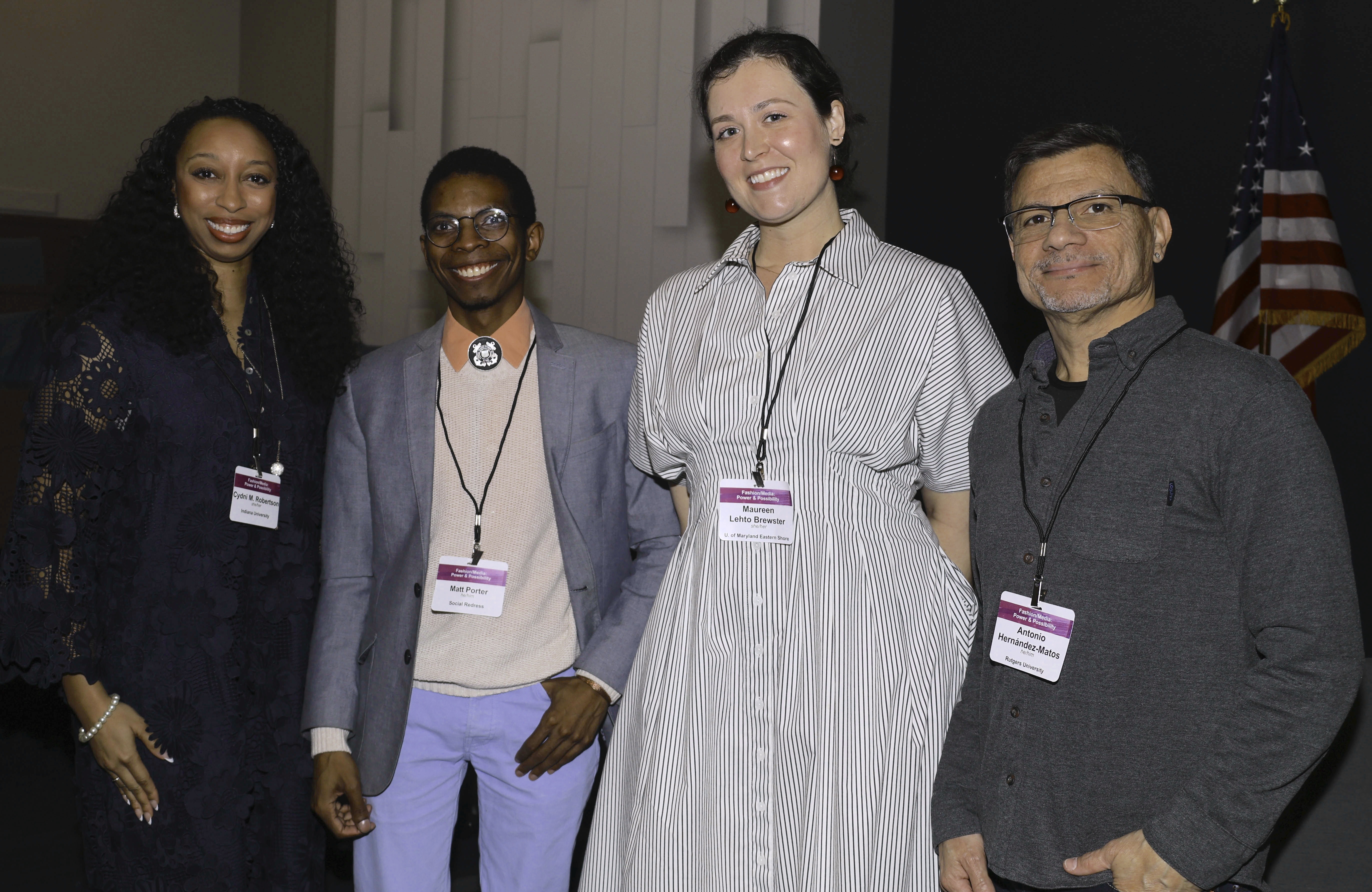 Panelists of Structures and Barriers of Fashion, Fashion and Media, Power and Possibility Conference, SMU, Dallas, Texas, on March 1, 2025. (Photo, Chloe Casdorph)
Puerto Rican historiography still argues that Puerto Ricans resisted the modernity represented by the U.S. from the beginning of the change in colonial power. However, this paper argues that at the start of the 20th century, Puerto Ricans had an ambiguous and tense relationship with a “colonial modernity” they both desired and feared. To support this argument, this paper examines two representations that coexisted in Puerto Rican periodicals: the first is the “masculinized” modern woman, portrayed as cold-blooded, egocentric, narcissistic, greedy, opportunistic, and calculating. The paper analyzes what critics perceived as the symbols of Puerto Rican women's masculinization: the fading “art of crying” and the bobbed hair that crowned the head of so many chicas modernas. Critics considered Puerto Rican modern women to be in the process of masculinization. They denounced fashion and modernity as the culprits, arguing that they were encouraging Puerto Rican modern women to dispose of any trace of sentimentality.
The other representation analyzed is the “naked” chica moderna, depicted as lost in worldly pleasures and always being on the verge of corruption and damnation. The paper examines the representations of the gradual “stripping” of modern women’s bodies by fashion, focusing on the symbolism of three pieces of clothing: the tube dress, the short skirt, and the bathing suit. Critics and commentators correlated fashion’s unveiling of women’s bodies with a public display of eroticism on their part, which represented a problem for the keepers of social morality, secular or religious. The paper shows how these two opposite representations of Puerto Rican women are the best examples of Puerto Rican's tense, ambivalent, and ambiguous relationship with the unforeseen consequences of colonial modernity.