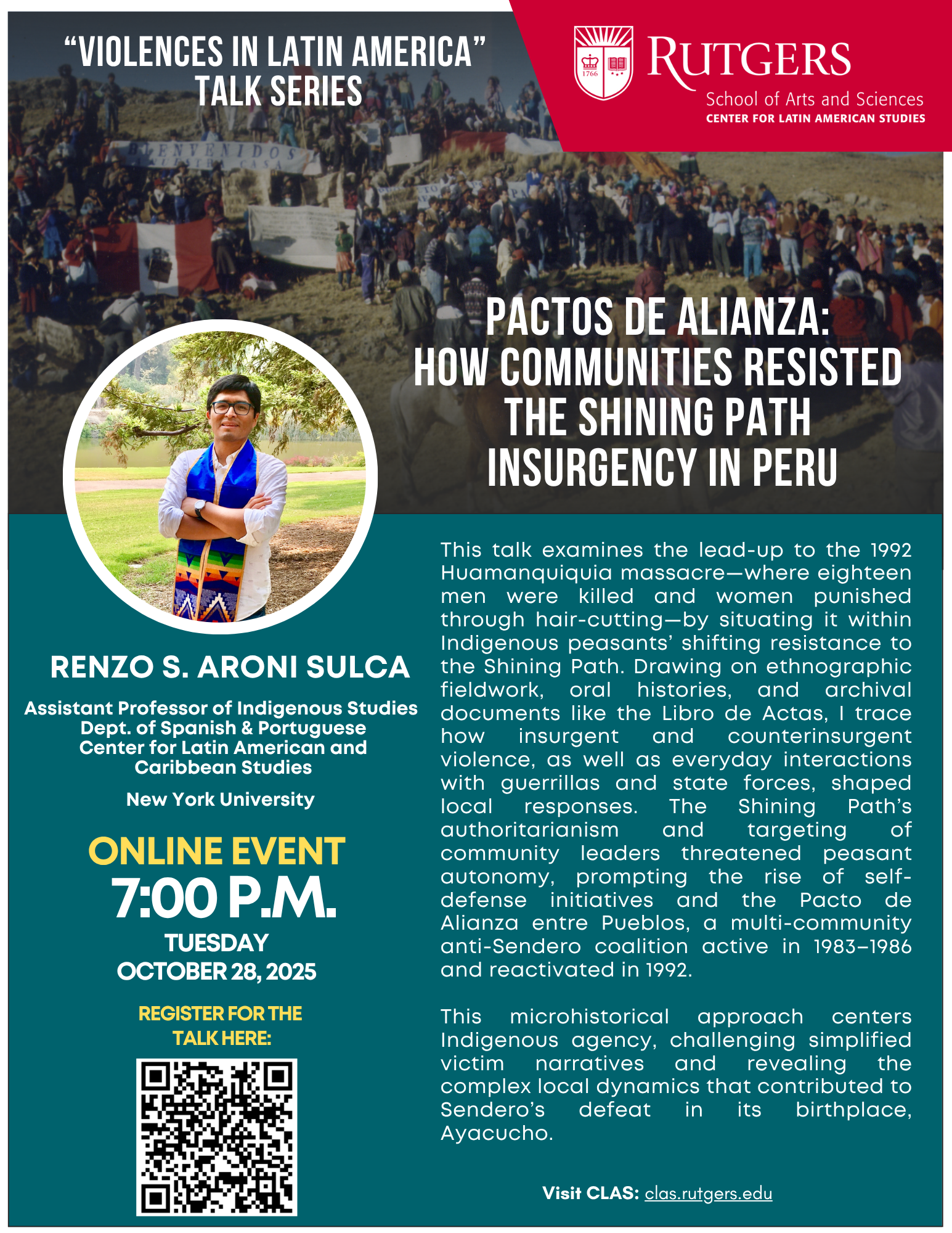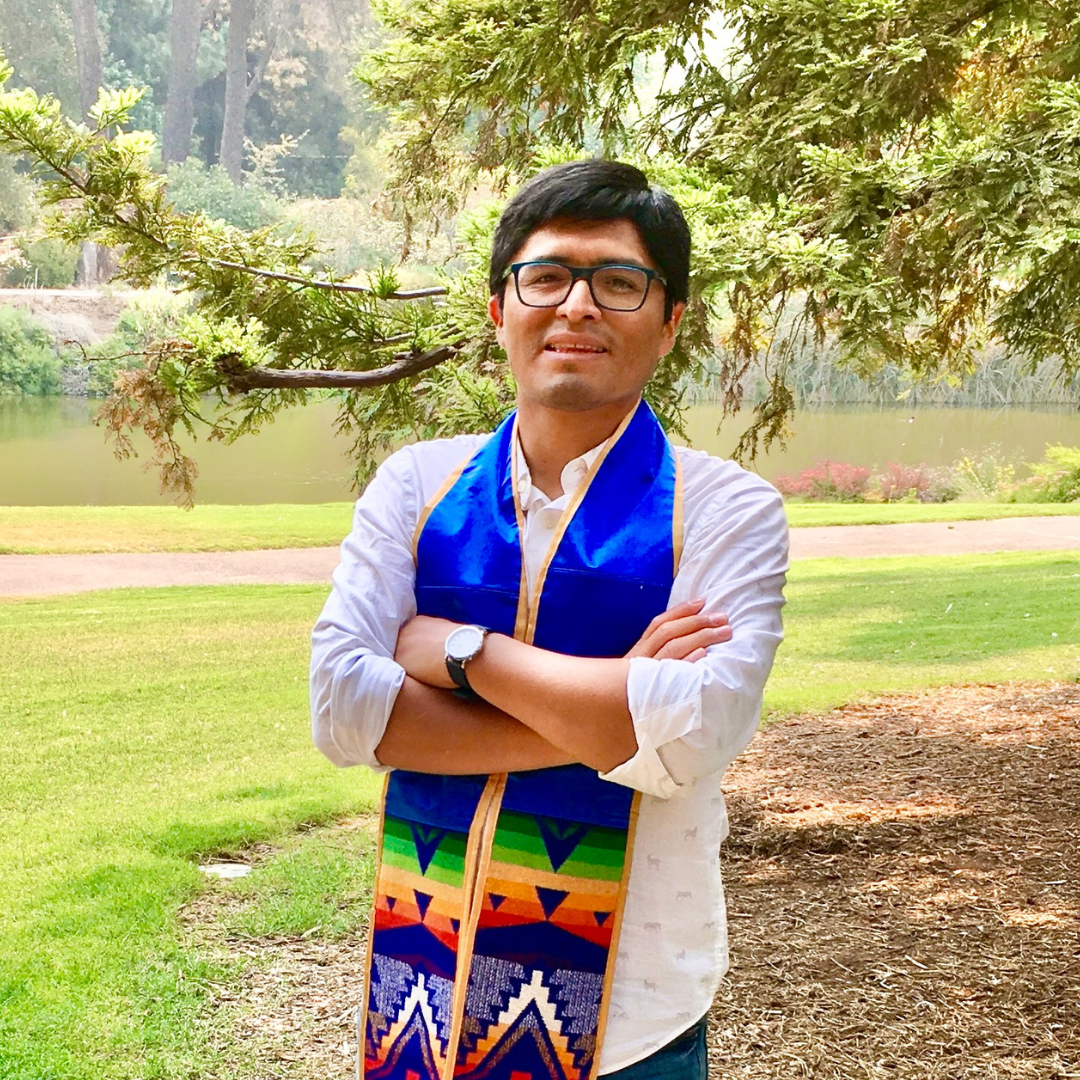
The Center for Latin American Studies (CLAS) is pleased to invite you to a lecture by Professor Renzo S. Aroni Sulca (New York University, Department of Spanish & Portuguese and of the Center for Latin American and Caribbean Studies), titled Pactos de Alianza: How Communities Resisted the Shining Path Insurgency in Peru. This event is part of the "Violences in Latin America" Talk Series and will take place online on Tuesday, October 28, at 7:00 p.m.
This talk examines the prehistory of the 1992 Huamanquiquia massacre, in which eighteen men were killed and women punished through hair-cutting, situating it within Indigenous peasants’ initially passive, then sustained and often violent, resistance to the Shining Path. Drawing on ethnographic fieldwork, oral histories with wartime participants, and archival documents such as the Libro de Actas, Dr. Aroni traces how patterns of insurgent and counterinsurgent violence, alongside everyday interactions with guerrillas and state forces, shaped local responses.
The Shining Path’s authoritarianism and targeted killings of community authorities threatened peasant autonomy, prompting self-defense and the formation of the Pacto de Alianza entre Pueblos, a multi-communal anti-Shining Path coalition active in 1983–1986 and reactivated in 1992. This microhistorical analysis centers Indigenous agency, challenging reductive narratives of victimhood and illuminating the complex dynamics of participation and local governance that contributed to the Shining Path’s ultimate defeat in Ayacucho, the birthplace of its insurgency.
Register for the talk: Here.
About the Speaker
Renzo S. Aroni Sulca is a New York–based Quechua self-taught musician-scholar, podcaster, and oral historian of modern Latin America, with a regional focus on the Andes. He is an Assistant Professor of Indigenous Studies in the Department of Spanish and Portuguese and the Center for Latin American and Caribbean Studies at New York University.
His research explores how violence, atrocities, and trauma are experienced and remembered, with particular attention to the complex relationships between civilians and combatants during and after armed conflict. His work draws on microhistory, autoethnography, and oral history, and he also studies Indigenous struggles for survival and rights, examining how communities sustain knowledge, language, and culture through performance, creative expression, and oral traditions. He frequently collaborates with grassroots communities, hip-hop artists, and Quechua language keepers across the Andes and in diaspora.
Dr. Aroni is currently completing a book manuscript titled Crossing a River of Blood: Resistance and Massacre in Peru’s Shining Path, and has published widely in both academic and public outlets. He is co-editor of Una revolución precaria: Sendero Luminoso y la guerra en el Perú, 1980–1992 (IEP, 2023), and his work has appeared in the Journal of Latin American Studies, Latin American Perspectives, NACLA Report on the Americas, and National Geographic.
Ahead of the talk, Professor Aroni recommends reading his article, "Gendered Atrocity and Haircut Punishment by the Shining Path in Peru." Find it here.