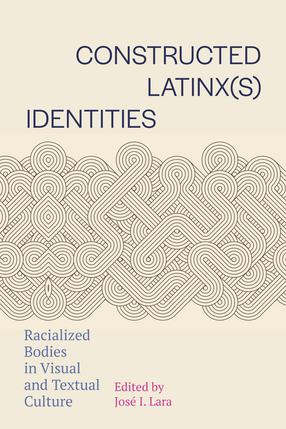
Jennifer Vilchez, a Ph.D. candidate in the Department of Women’s, Gender, and Sexuality Studies, has recently published a chapter titled “How We Became Latinx: The Role of Data on Identity in the Twenty-first Century” in the new volume Constructed Latinx(s) Identities: Racialized Bodies in Visual and Textual Culture, edited by José I. Lara.
In “How We Became Latinx,” Jennifer analyzes Alex Rivera’s film Sleep Dealer as a conceptual metaphor to develop her theoretical concept of “tethering.” Tethering provides a framework for understanding the role of data in shaping contemporary identity formation. Through the revolutionary collaboration of the film’s three main characters, she illustrates what “tethering” allows scholars to perceive and accomplish when studying identity. Constructed Latinx(s) Identities is currently available as an open-access edition on Fulcrum and can be freely downloaded as a PDF, EPUB, or MP3 audiobook. Hard copies are also available for purchase through the publisher here, as well as wherever books are sold.
Jennifer’s dissertation, co-chaired by Ed Cohen and Carlos U. Decena, examines the historical conditions and effects of how Hispanics and Latino/as have been categorized by the state, institutions, the media, and activists—and what the category Latinx makes possible as a new way of representing this population. Her project reveals how categories can turn individual lives into targets of political, scientific, and bureaucratic control, while also opening liberatory possibilities when they disrupt conventional forms of classification.
In addition to her research, Jennifer currently serves as a Graduate Fellowship Advisor at GradFund, the external fellowships office in the School of Graduate Studies.
Congratulations on this exciting publication, Jennifer!