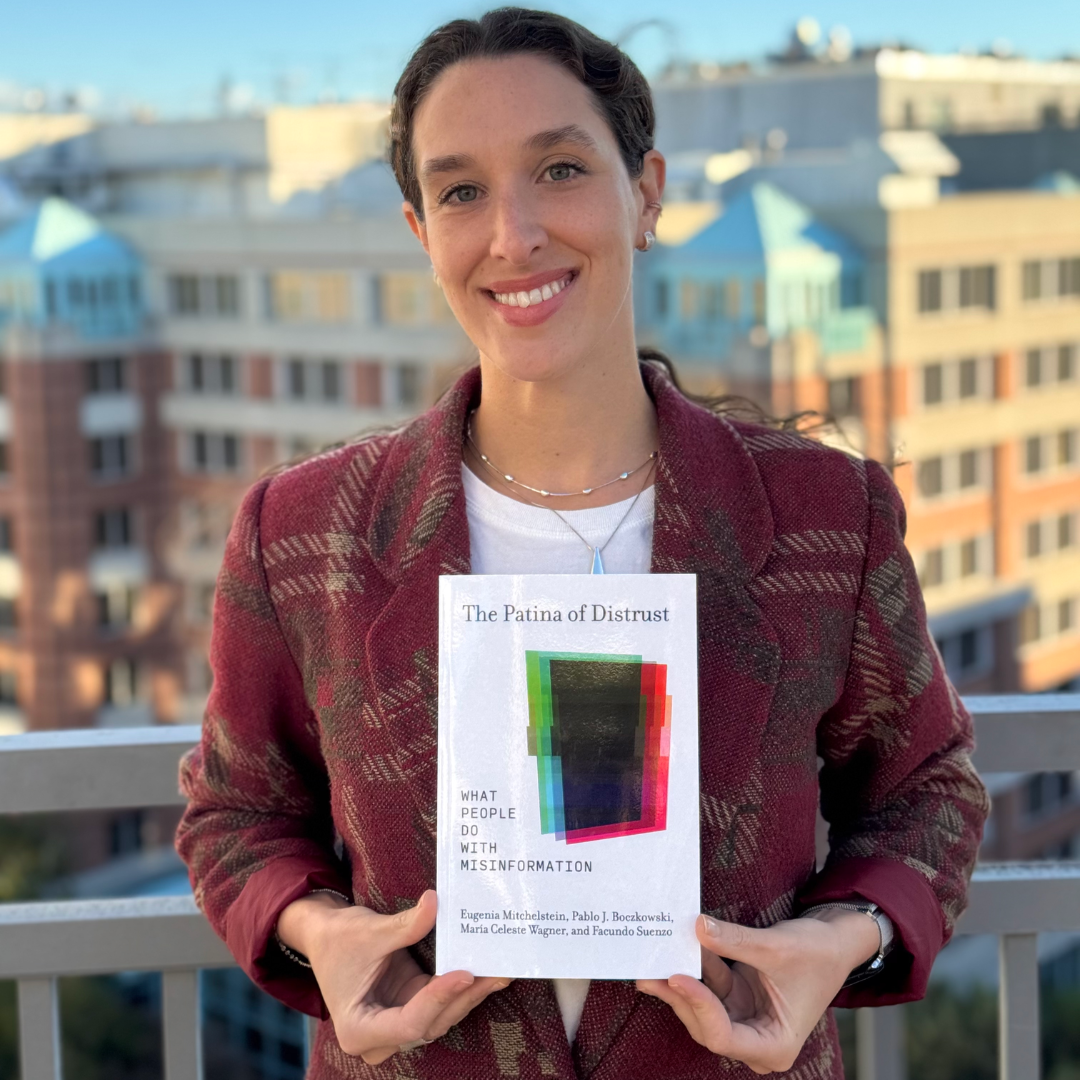
We are delighted to share that Celeste Wagner, Assistant Professor in the Department of Journalism and Media Studies at Rutgers University since Fall 2024, has just published her coauthored book, The Patina of Distrust: What People Do with Misinformation (MIT Press). The book, which focuses on Argentina—her home country—will soon be available as an open-access title.
The Patina of Distrust examines how people in Argentina interpret and act on misinformation in their everyday lives, emphasizing reception as a crucial yet overlooked dimension of misinformation research. Drawing on a historically grounded mixed-methods design centered on the 2019 presidential election, the book integrates a three-wave nationally representative panel survey, survey experiments, and more than 70 qualitative interviews.
Wagner and her coauthor argue that distrust in Argentina operates not merely as a corrosive force within democratic life, but as a “patina”—a historically learned stance of awareness, restraint, and skepticism. Much like the protective layer that forms on artworks over time, this patina, rooted in social memory, helps people navigate information critically. While it can shield individuals from believing misinformation, it can also make them resistant to certain forms of correction.
Importantly, the book’s framework extends beyond Argentina. The authors highlight that the conditions that shaped this patina—such as institutional volatility, political polarization, and dense media environments—are common across Latin America. As a result, the concept can help explain how publics in low-trust contexts across the region engage with information. In the book’s Coda, Wagner and her coauthor explore how this patina of distrust also sheds light on the election of right-wing president Javier Milei in the context of the COVID-19 pandemic.
Congratulations to Professor Wagner on this important and timely contribution to the study of misinformation and democratic life.
You can find the book here.