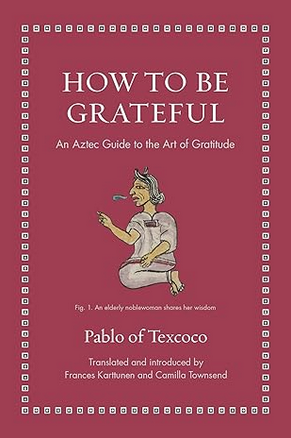
Camilla Townsend and Frances Karttunen have just published How to Be Grateful: An Aztec Guide to the Art of Gratitude with Princeton University Press. We spoke with Townsend about the newly released book, and this is what she told us.
What is the book about?
How to be Grateful contains a set of dialogues written in the second half of the 16th century by an Indigenous man in Texcoco (Tesh-KO-ko), Mexico. Texcoco was one of three cities that had composed the Aztec Triple Alliance just two generations earlier. It seems that a Spanish friar had asked a student or an acquaintance named Pablo to prepare some dialogues that could be used to teach Nahuatl, the Aztec language, but the writer took it upon himself to use the assignment to preserve and convey to future generations his people’s values and philosophy. I love the text because it only gives cursory nods to Christianity. Most of the time, the author has his characters express old Aztec ways of thinking. They wanted people to be grateful to generations past for attempting to make the world better, and to “pay it forward” by working on behalf of people yet to come. They demanded a lot more than just being grateful for our daily bread!
How did the idea of translating Pablo de Texcoco’s dialogues begin?
More than forty years ago, the linguist Frances Karttunen worked extensively with the original manuscript that she and her partner had found in the Bancroft Library at UC Berkeley. Sadly, they published their work in a little-known venue, a series of books and pamphlets printed at the UCLA Latin America Center. Now Fran is in her 80s. When I asked her if she would be interested in producing a new edition with a major press, she immediately agreed.
In the PUP description of the book, it is mentioned that it is an "accessible translation that also features the original Nahuatl text on facing pages." Could you please elaborate a little about the idea of "accessible translation"?
Most of Fran’s existing translation we kept, but we did make some changes. In order to make the text more relatable, she had buried some of the Aztec idioms beneath a good English translation, and we decided to bring some of those to the surface. For instance, in the 1980s, she might have written, “The girl is his much-loved daughter.” Now we translated more directly: “The girl is his precious necklace, his precious feather.”
You and Prof. Karttunen are the translators of the work. Could you please explain how you did the translation as a team?
I wrote a new introduction and rekeyed the whole transcription. (There were computers in the 1980s, but the software in use then doesn’t talk to today’s software very easily!). Most of the translation remained Karttunen’s, but both collaborated to revise portions to highlight Nahuatl idioms and make the text resonate more with contemporary readers.
Is there going to be a book presentation soon?
In the spring, the Association of Nahuatl Scholars will meet in New Orleans. We will give the book a launch right there, on the very day of Fran’s 85th birthday! In the spirit of the Aztecs themselves, we will thank her for all she did for scholarship on the Nahuas, and she has told me that she plans to thank us for continuing to care despite all that is happening in the world, and for working to keep alive all that we have learned about human language and history. It should be quite a moment.