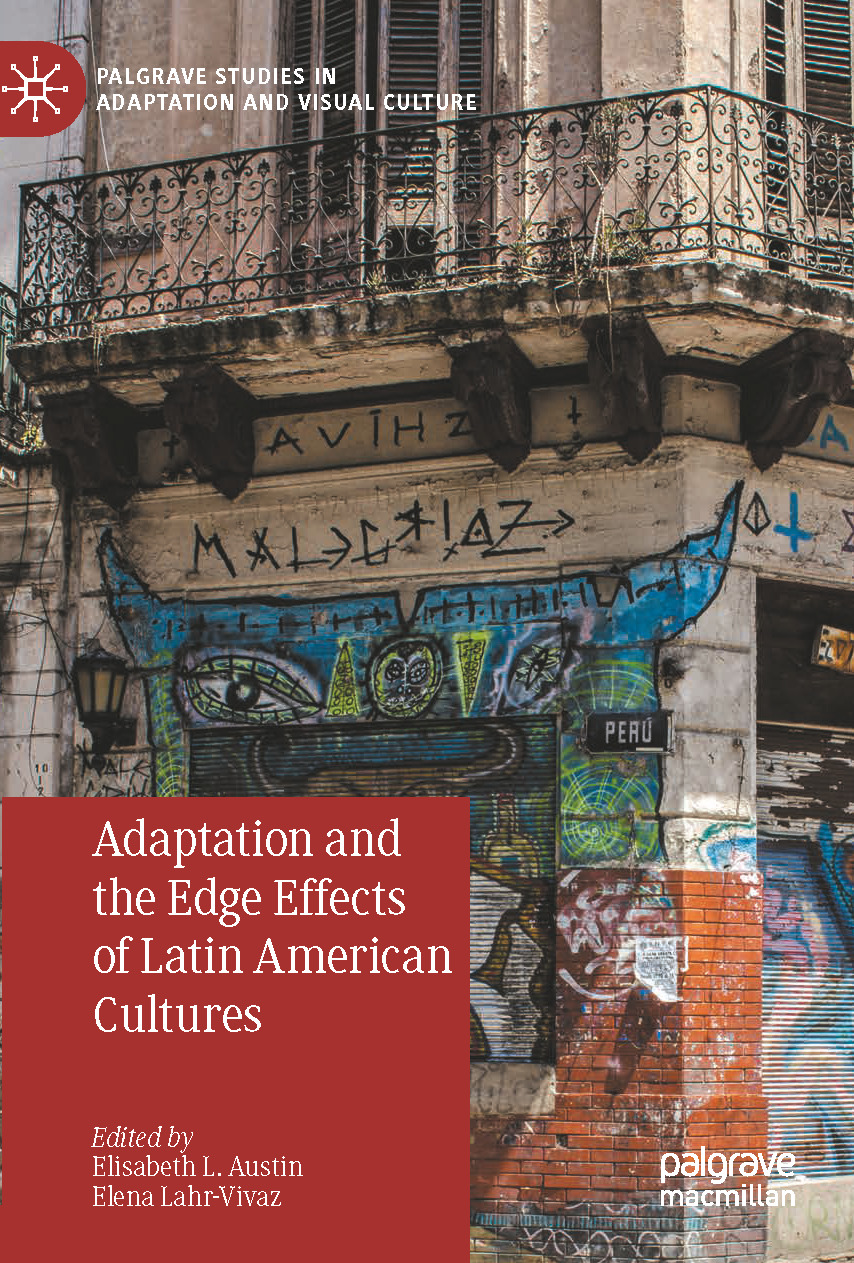
We are delighted to share that the co-edited volume Adaptation and the Edge Effects of Latin American Cultures (Palgrave Macmillan, 2025), edited by Professor Elena Lahr-Vivaz (Department of Spanish & Portuguese Studies, Rutgers-Newark) and Elisabeth L. Austin (Virginia Tech) is now in print.
We spoke with Professor Lahr-Vivaz about the origins of the volume, the conceptual force of the “edge effect” concept, and the diverse contributions that illuminate the intersections of Latin American cultures and their artistic and textual expressions. Here’s what she shared with us.
How did the idea of creating the book was born? Please explain what an "edge effect" is and how it informs the chapters of the book.
My colleague Elisabeth Austin and I were both writing about adaptations, and we organized a series of conference panels that brought together scholars working in Latin American Studies and Adaptation Studies. These resulted in some incredibly rich discussions, and led us to the realization that the two fields overlapped significantly but rarely entered into conversation with each other. So we started to think about the possibility of putting together a book with contributions from scholars in Latin American Studies, Adaptation Studies, and Film Studies. We wrote up a proposal, and were delighted to have it accepted for the Palgrave series on Studies in Adaptation and Visual Culture.
We borrow the term “edge effect” from Ecology Studies, where it was coined to refer to the increased number of species that often exist in the overlapping area at the edges of two neighboring ecosystems. The term has also been used in game studies, fine arts, and finance, among other fields, and it seemed particularly appropriate for our discussion of adaptations. Each of our contributors engages with the idea of the edge effect in a slightly different way, demonstrating the flexibility of this lens for analyses of adaptations from Latin America, the Caribbean, and the U.S. borderlands.
Thinking about who should read this work, could you please offer a brief example that shows in a more concrete way “the complex interrelations between Latin American cultures and their textual and artistic expressions”?
Contributors to the volume analyze a range of different texts that demonstrate the complex interrelations of Latin American cultures. Catalina Andrango-Walker and Martina Thorne turn to the archives to explore the ties between lived history and textual adaptations in, respectively, Chile and Peru, for instance, while Jacqueline Bixler delves into a Mexican playwright’s adaptation of her own work and Elisabeth Austin details an Argentine novelist’s adaptation of a famous 19th-century poem.
In my case, I analyze “La guagua aérea” (“The Flying Bus”): an essay by Puerto Rican writer Luis Rafael Sánchez that was first read aloud at a conference at Rutgers-Newark organized by professor Asela Rodriguez de Laguna, and that was subsequently adapted multiple times, including to the screen and to the stage. I draw on Adaptation Studies, as well as Archipelago Studies, to delve into the ways that the aerial, archipelagic space of the “flying bus” foregrounds the edges and intersections between identities as well as cultures.