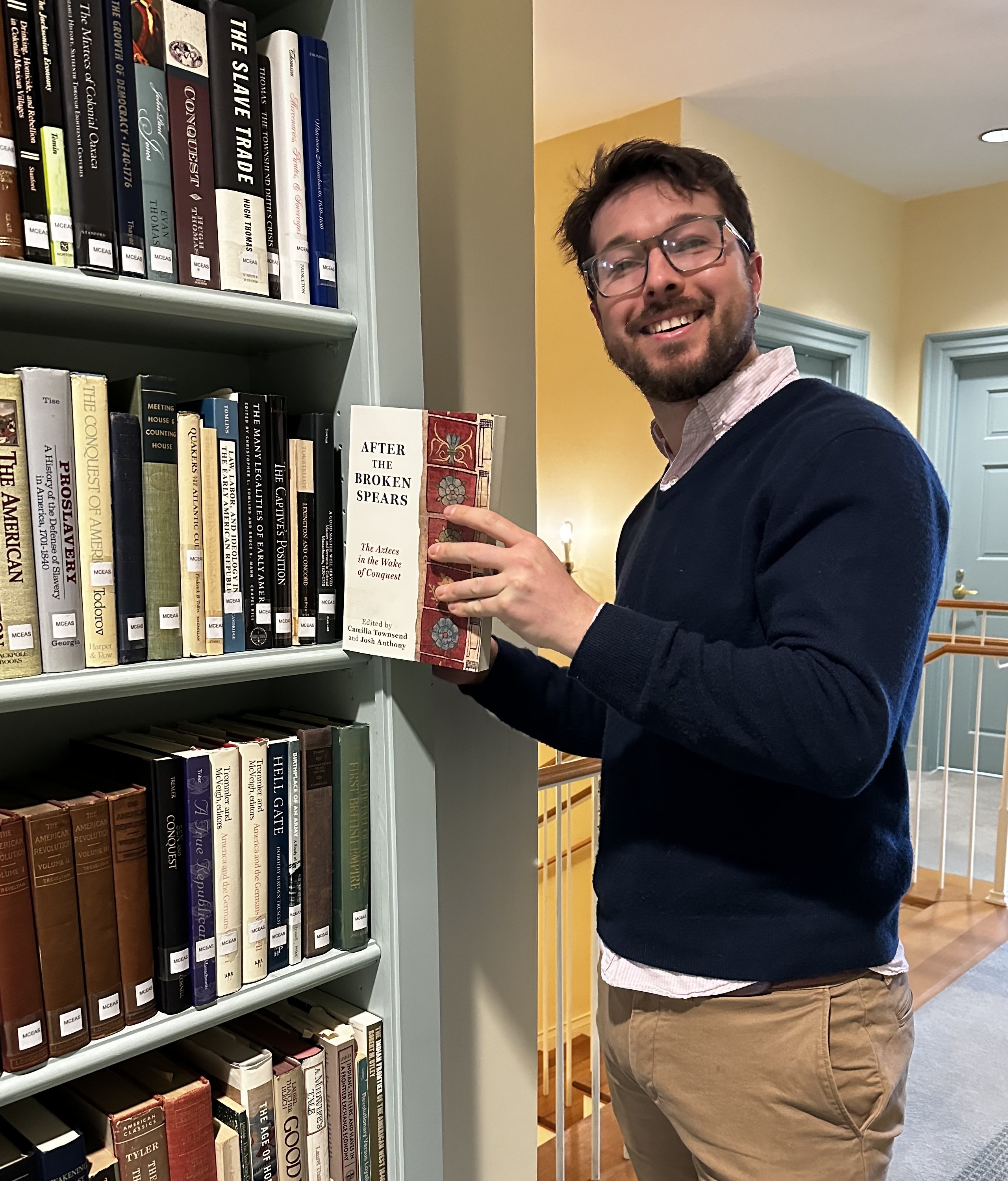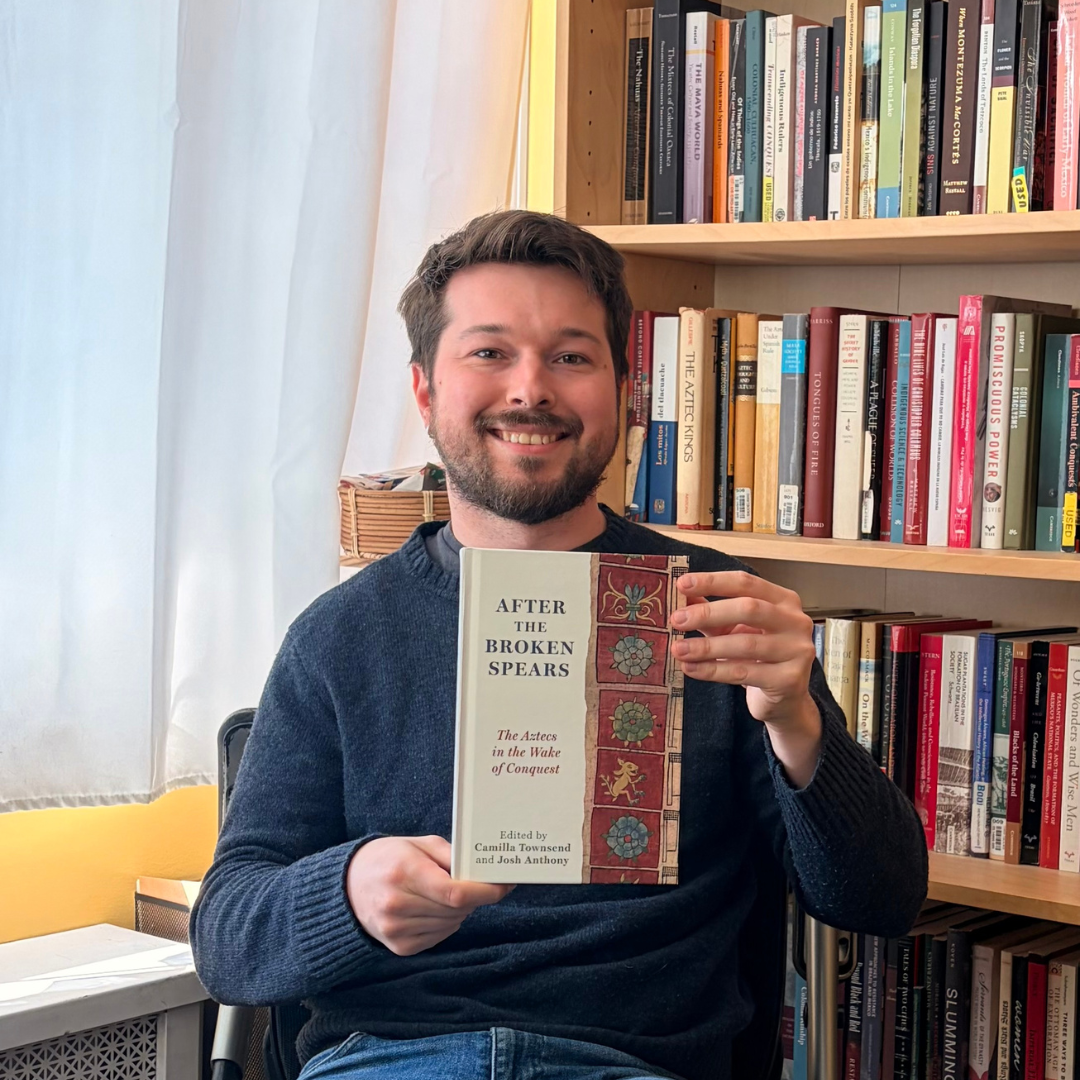
Creating a book that bridges five centuries and three languages is no small feat. After the Broken Spears: The Aztecs in the Wake of Conquest (2025, OUP) is more than just an edited volume. This behind-the-scenes look at the project's evolution reveals how a traditional epilogue transformed into a deeply interwoven dialogue between past and present. In this conversation, Josh Anthony, PhD candidate in history as co-editor of the book, pulls back the curtain on the "1522 Collective," the challenge of translating 16th-century Nahuatl, and why this history is more "alive" today than ever before.
What was the genesis of After the Broken Spears: The Aztecs in the Wake of Conquest?
The project began with a Zoom conversation between me and Celso Mendoza, who was then a fellow grad student at Rutgers, and is now an Assistant Professor at the University of Illinois, Chicago. This was during the height of the pandemic, in December of 2020. We were talking about how the different Nahuatl sources we were researching preserved memories of life just after the Spanish conquest in 1521, even though they were written many decades later in the late sixteenth and early seventeenth centuries. Celso and I were struck by how similar these descriptions felt to what we experienced in our contemporary moment, where everyone knew the world was changing, but we didn’t yet know how it was changing, or what it was becoming. So we contacted Camilla Townsend, our dissertation advisor, and proposed a collaborative project that collected and analyzed different Nahua perspectives on the years that followed the conquest. We joked that, unlike other books coming out that commemorated the 500-year anniversary of the fall of Tenochtitlan in 1521, we wanted to write something about 1522.
Cami became passionate about the idea, and she began reaching out to publishers. During the summer of 2021, Oxford University Press said they were interested, so Cami organized a meeting with me, Celso, and her other current graduate students working on Nahuatl sources: Clio Isaacson, Tara Malanga, and Peter Sorensen. We discussed other scholars we wanted to bring into the project, sent out invitations, and started planning what we were calling the conference of the “1522 Collective.”
How did the project change once it began?
When the conference met in 2022, we had two different kinds of participants. First were scholars working with early Nahuatl sources. Beyond those I mentioned previously, our 1522 Collective now includes Travis Jeffres, one of Cami’s former students; Sandra Acocal, a Nahua scholar from Tlaxcala starting her second PhD at Rutgers; and two leading scholars in our field beyond the Rutgers orbit, Barbara Mundy and Justyna Olko. We also invited five Indigenous Mexican scholars, whose work considered the ramifications of conquest in contemporary Mexico , but were not themselves experts in the early Nahuatl materials. These were Abelardo de la Cruz, Eduardo de la Cruz, Baruc Martínez, Yásnaya Aguilar, and Selene Galindo. The original idea was to combine their reflections into an epilogue for the book.
Once the conference got going, however, it quickly became clear that this plan would not be sufficient. The contemporary reflections often had direct parallels with the historical essays, and we wanted the book to reflect the interplay between the past and the present we saw at the conference. Eduardo offered a solution: instead of placing the reflections together at the end of the volume, we interweave them throughout the book. I’m really thankful for this idea, since it made the structure of the book so much richer and more interesting than it would have been otherwise. It also lets readers see the “wake of conquest” we allude to in the book’s title: how the impact of early Spanish colonialism persisted, and persists today.
Can you tell us what you enjoyed most about editing this book?
The thing I enjoyed most was seeing all the connections emerge between the different chapters. One thing Celso and I had been talking about since 2020 was that Nahuas expressed much more dissatisfaction and criticism of early Spanish colonialism than has been commonly accepted. That thread definitely stood out in the chapters our authors submitted. I’m thinking specifically about Celso’s chapter, about a Nahua priest who preached the end of days because of Spanish rule; Travis’s chapter, on the forced relocation of a Nahua family to the far north; and Justyna’s chapter, which analyzes how Nahua leaders policed their communities to avoid confrontations with the Spanish. Reading those chapters together provides a fascinating portrait of the limits of Indigenous resistance to colonial violence in sixteenth-century Mexico. In turn, this offers insight into violence in contemporary Mexico, as Selene and Yásnaya discuss in their contributions.
One unifying factor that surprised me was the emphasis on humor that appears in so many of our sources. That’s especially true for Cami’ and Sandra’s chapters, but there are also traces of that in Tara’s, Clio’s, and my own. Historians of early Nahuatl sources often skip past the jokes and funny stories that appear scattered in our documents. But seeing them across so many different sources made them impossible to ignore. I found it profound that so many Nahuas living in the immediate wake of conquest used humor to explain their past. After working on this project, I now feel strongly that comedy and humor needs to play a larger role in our conversations about Indigenous cultural survival and revitalization – a topic discussed by Abelardo at length in his essay.
The book required a lot of translation. Can you describe that process a little?
This book involved translations of many different kinds. Most of the historical essays begin with an original translation of a Nahuatl source prepared by the author. We worked hard to standardize how we presented these translations and to ensure they would be useful to experts while remaining legible for a broad audience. In the companion website, prepared with the help of Rutgers’ own Jeongeun Park, we’ve presented each of these translations alongside a transcription. This will be helpful for anyone learning to work with early Nahuatl sources, or who wants to use our translations for their own research.
Most of our Indigenous contributors prefer to write in their Native languages or in Spanish, so Cami and I worked with them closely to create English translations that captured their original words. It was especially interesting doing that with Eduardo’s poem and Baruc’s essay. Both pieces were submitted bilingually, in Nahuatl and Spanish, and the authors wanted them to appear in Nahuatl and English. It’s rare to see contemporary Nahuatl writing appear in the same book as Nahuatl writing from the early colonial era, so I’m proud we were able to provide translations of both forms of Indigenous literature for our readers.
At our 2022 conference, Eduardo had the idea to include summaries of each chapter written in Nahuatl. Most of the Nahua history that is written today is in a European language, normally Spanish or English. Eduardo wanted the book’s contents to be readable by people in Nahua communities in their own language. Oxford agreed to the proposal, so we worked to prepare an appendix of Nahuatl-language summaries of each chapter that appears at the end of the book and on our companion website. Most of the credit for that should go to Agustín Camargo Flores and Pedro Kemach Hernández, two teachers of contemporary Nahuatl who collaborated with Sandra and myself to produce these summaries.
What audiences do you imagine for After the Broken Spears, and how do you imagine those audiences using the book?
Our goal with this book was to create something that could welcome newcomers into the field while also being relevant to other scholars of early Mexico and the Nahua world. After the Broken Spears is thus something of a hybrid between a primary source reader and a traditional academic edited volume. Newcomers should be able to appreciate the historical essays as presentations and explanations of Nahuatl sources. Experts should be able to read them as historiographic arguments about early Nahua history and the way we read Nahuatl sources. That’s the goal, anyway!
When I present at conferences, I often get asked for recommendations for readings that professors can assign their students. There’s been some amazing work done in previous decades to prepare compilations of translated Nahuatl sources suited for teaching, but there’s still a lot of gaps. We hope that After the Broken Spears can fill some of those gaps. I’ll shout out here Peter’s chapter, which can serve as a great introduction to the historical songs created by Nahuas before and after Spanish conquest; Clio’s chapter, which considers women’s perspectives in royal Nahua marriages; and Barbara’s chapter, which offers a careful and nuanced exploration of Indigenous slavery in late precolonial and early colonial Mexico. Those would be particularly exciting tools to bring into the classroom.
Our title is a tribute to two foundational texts in Mexican history and Nahuatl studies that are familiar to any expert in our field: Miguel León-Portilla’s Visiones de los vencidos [1959], translated into English as The Broken Spears, and James Lockhart’s The Nahuas After the Conquest [1992]. Together, these books prepared the way for scholars to use Nahuatl sources to unlock a deeper understanding of early Indigenous culture. With our book, we hope to show that we are continuing to find new ways to use Nahuatl sources to write more relevant, more accurate histories of early Mexico. Cami explains the methodologies necessary to write these kinds of histories in the introduction, and I’m really looking forward to what other experts think of her explanation.
Are there plans for a Spanish translation?
That depends on how the book is received! I would love for there to be a Spanish translation. Many of Cami’s previous books have been translated into Spanish and are popular in Mexico, and I would be ecstatic if After the Broken Spears joined that group. One thing we talked about a lot over the course of this project is that there needs to be more conversation between scholars in this country and in Mexico. English-Spanish and Spanish-English translations are a great way to help bridge that divide. And of course, I would greatly look forward to the day when someone requests a full translation of the book into Nahuatl.
The official book launch for After the Broken Spears takes place this Friday, February 20 at 1:00 PM.
Register for the Zoom event here to join the discussion on Nahua history and Indigenous survival.