
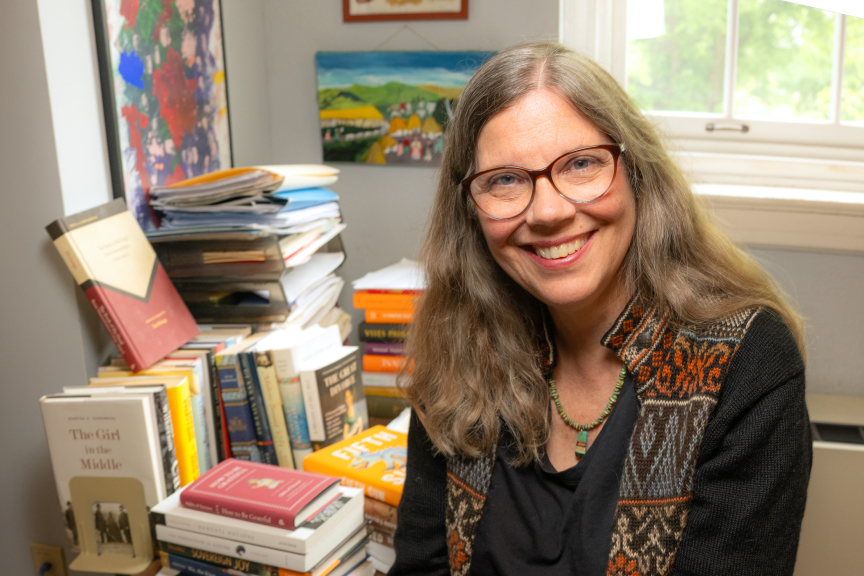
A massive shout-out to our very own Camilla Townsend!
Being elected to the American Academy of Arts and Sciences is one of the highest honors in the field, and we couldn’t be more excited to see her pioneering work in Aztec history recognized.
Congratulations, Camilla, on this incredible milestone in your career!
Camilla Townsend’s academic career was already off to a promising start at Colgate University in the 1990s when she took a summer class that would transform her work as a historian.
The course introduced Townsend to the Nahuatl language of the Aztecs, the Indigenous civilization in central Mexico conquered by Hernán Cortés and the Spanish conquistadors in the 1500s.
Townsend, initially a scholar of colonial economic history, was struck by the rich array of Nahuatl literary sources and emerged from the course with a bold new calling: Telling the story of the Aztecs in their own words rather than through the accounts of their European conquerors.
“I have spent the past 30 years reading the histories that the Aztecs wrote in their own language for their own grandchildren, and trying to make them comprehensible to modern people,” Townsend said. “What I wanted to do is serve as an effective bridge between both worlds.”
In seminal works like Fifth Sun: A New History of the Aztecs, Townsend drew from the writings of young Aztec men who learned the Roman alphabet from the Spanish friars who accompanied Cortés in his conquest.
Unbeknownst to the friars, who had taught the alphabet with the goal of converting the Indigenous people to Christianity, the Aztec students took their newly acquired knowledge of the phonetic alphabet home and used it to record their elders’ recitations of history and other stories in their own language.
“They are marvelously rich sources—full of subtle political commentary, raunchy humor, and evocative imagery,” Townsend said. “They allow us to catch a glimpse of how these Indigenous people experienced the world, both before Europeans arrived, and at the time of conquest.”
The author of numerous works on Native American history, including On the Turtle's Back: Stories the Lenape Told Their Grandchildren, Townsend is also known as a dedicated classroom teacher at Rutgers. Last fall, after being elected to the British Academy, she declined to take a transatlantic trip for the installation ceremony. The reason? She’d miss a week’s worth of her classes.
She recently co-edited with a Rutgers graduate student the book After the Broken Spears, which explores early Indigenous history in Mexico and includes essays by current and former Rutgers students.
“What I long for is to see a world in which more people truly care about those who loved these shores long before we came along,” Townsend said. “So it is immensely important for me to pass along whatever I have learned to Rutgers students, so that they may carry it forward.”
Townsend said she felt deep joy and gratitude to be inducted into the American Academy of Arts and Sciences.
“The Aztecs used to say something that literally translates as ‘people have befriended me," Townsend said. “In our own times, we would express the same concept by saying, ‘I am grateful.’
“Nechicnelique. I am indeed grateful.”